Blog

  • Studio vs 1-Bedroom Rent Dubai: Cost Guide 2026

    Studio vs 1-Bedroom Rent Dubai: Cost Guide 2026

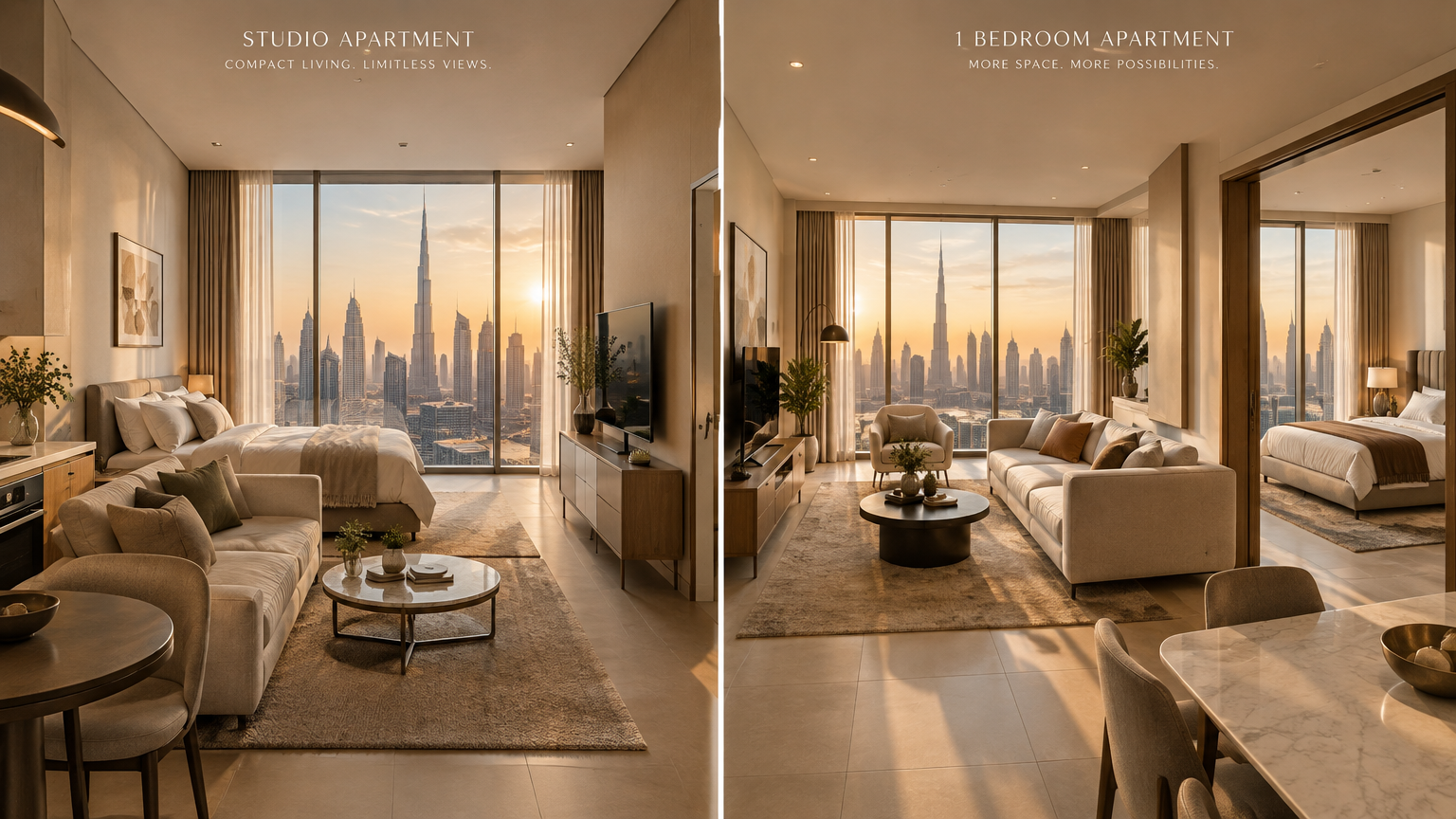
    Choosing between a studio vs 1-bedroom rent Dubai depends on your salary, lifestyle, and work arrangement. In this guide, we compare rental costs across Dubai’s key districts, explore whether the premium justifies the extra space, and help you decide which option suits your needs in 2026.


    Quick Summary

    • We compare studio vs 1-bedroom rents across Downtown, Marina, Business Bay, and affordable areas, including AED gaps and value per square foot.
    • We explain resale and sub-letting rules, Dubai’s shared housing regulations, and what you must know legally.
    • We explore lifestyle factors: working from home, privacy, commuting, and space needs for singles, couples, and families.
    • We offer a salary-based decision framework to determine whether upgrading to a 1-bed is justified for your profile.
    • We conclude whether the 1-bedroom premium makes financial sense in 2026 Dubai for different renter types.

    Studio vs 1-Bedroom Rent in Key Dubai Areas (2026)

    Here’s what actual rents look like across popular Dubai districts, based on new tenancy contracts registered with the Dubai Land Department:

    Area / Community Median Studio Rent (AED/year) Median 1-Bedroom Rent (AED/year) Annual Premium Difference Key Features & Sq-ft‐per‐Dirham Note
    Downtown Dubai ~ AED 75,000 ~ AED 110,000–140,000 depending on size/view AED 35,000-65,000 increase – ~50-80% more Studios ~400-600 sq ft; 1-beds ~700-1,000 sq ft. Per dirham, you pay more per sq ft for a 1-bed in premium zones Downtown, especially with views.
    Dubai Marina / Business Bay ~ AED 55,000–78,000 for studios ~ AED 75,000–101,000 for 1-beds Premium of AED 20,000-30,000 – ~30-60% more Studio size slightly smaller (~400-550 sq ft); 1-beds offer significantly more space. Value per dirham improves versus Downtown.
    Affordable Areas (Al Warsan First, International City, Deira) AED 25,000-45,000 for studios AED 35,000-60,000 for 1-beds Premium of ~AED 10,000-15,000 – 30-60% more The space difference is real but smaller; amenity levels are lower. Square foot per dirham tends to favour 1-beds slightly more in these areas.

    Understanding Value Per Square Foot

    The cost-per-square-foot varies significantly across Dubai:

    • Downtown: Studios cost AED 80–110 per sq ft; 1-beds AED 95-130+ for views. The premium reflects location and prestige.
    • Marina and Business Bay: Studios run AED 85-100/sq ft; 1-beds AED 90-110/sq ft depending on floor and finish. The gap is narrower here.
    • Lower-cost areas: Studios average AED 50-70/sq ft; 1-beds AED 60-80. Because 1-beds offer more usable living space, the extra cost often delivers better utility for couples or remote workers.

    When Paying More for a 1-Bedroom Makes Sense

    The decision depends on your work style, household composition, and personal priorities. Below are the main scenarios:

    Scenario Best Option & Why
    Single professional, office-based work Studios often suffice. You sleep, host small guests, and spend most time at work. Lower rent means more disposable income.
    Single professional, partly remote work A 1-bed allows dedicated workspace (desk, lighting, proper internet setup). The premium pays off for productivity and wellbeing.
    Couple A 1-bed is recommended. It provides privacy, better space for entertaining guests, and reduces the compromise of living/bedroom combinations in studios.
    Small family or considering children 1-beds remain tight for more than two people, but offer more flexibility than studios. A 2-bed is preferable for families planning growth.
    Location and lifestyle priorities Proximity to work, amenities, and leisure (beach, parks) can justify the premium. Views and prestige also matter in certain areas.

    Legal Rules: Resale, Sub-letting & Shared Housing

    Understanding Dubai’s rental laws protects you and impacts the true value of your rental choice.

    Sub-letting Requirements

    Under Dubai Law No. (26) of 2007, you can only sub-lease a property with written approval (NOC) from your landlord. Without it, you breach your contract. Many landlords refuse sub-letting requests, especially in premium areas.

    Shared Housing and Occupancy Rules

    Dubai’s updated shared housing law (Law No. 4 of 2026) regulates renting out individual beds or informal roommate arrangements. These require:

    • Formal permits from the municipality
    • Strict occupancy standards (e.g., maximum persons per unit)
    • Proper registration and documentation

    Using a 1-bed to sub-lease part of it without permission risks eviction and legal penalties.

    Ejari Registration

    All tenancy contracts must be registered with the Dubai Land Department (Ejari). This ensures legal protection, proper enforcement of landlord/tenant rights, and facilitates repairs and maintenance. Sub-leases must follow the same registration requirements if allowed.


    Hidden Costs Beyond Base Rent

    Service Charges and Amenities

    Premium 1-beds in Downtown or Palm Jumeirah include higher service charges. These cover elevators, pools, security, gyms, and maintenance. Budget an extra 5-15% of rent annually for these costs.

    Working From Home Space

    If you work remotely several days per week, a 1-bed provides separation between work and rest. Studios force you to combine living and sleeping areas, causing fatigue and reduced productivity. This benefit often justifies the premium for remote workers.

    Commute and Transport

    A central 1-bed closer to your workplace may save money on transport. Calculate monthly transport costs: if a premium location saves you AED 500/month in commute fees, the 1-bed effectively costs less.

    Guest Hosting and Privacy

    Couples or social professionals benefit from a separate living room. Studios force guests into your sleeping area, reducing comfort and privacy. This lifestyle factor is worth considering.

    Investment Potential

    If you plan to buy or invest later, 1-beds in Marina often yield better long-term returns than Downtown units. However, the premium purchase price affects your margin, so research your intended area carefully.


    Should You Rent a Studio or 1-Bedroom? Decision Guide

    Salary Band & Household Type Studio Typically Better 1-Bedroom Recommended
    Low salary (< AED 150,000 p.a.), Single, office-based ✔ Studio in affordable areas (Deira, Al Warsan, International City) 1-bed too high cost burden
    Mid salary (AED 150-400k), Single, remote 2-3 days/week Studio acceptable but limits productivity ✔ 1-bed in Marina or Business Bay balances cost and comfort
    Mid salary, Couple, occasional guests Studio creates compromise and tension ✔ 1-bed in mid-to-high-end area recommended
    High salary (> AED 400,000), Couple or small family Studio rarely fits lifestyle needs ✔ 1-bed in premium district; consider 2-bed for families

    Frequently Asked Questions

    What is the typical premium percentage when upgrading from a studio to a 1-bedroom?

    The premium ranges between 30%–60% annually across most Dubai districts. In Marina and Business Bay, a studio costs AED 55,000-78,000 per year, while a 1-bed runs AED 75,000-101,000—roughly a 40% increase. In affordable areas, the gap is similar (30-60%), but the absolute AED difference is smaller.

    Does a 1-bedroom offer better value per square foot than a studio?

    Not always. In premium zones like Downtown, 1-beds often cost more per square foot, especially with views or premium finishes. However, in mid-range and affordable communities, 1-beds typically deliver more usable space per AED spent, making them better value for money.

    Can I sublet a 1-bedroom apartment to reduce costs?

    Only with written permission from your landlord. Dubai’s shared housing law requires formal permits, occupancy compliance, and proper registration. Subletting without approval risks eviction and legal penalties.

    Is the price gap between studios and 1-beds shrinking in 2026?

    Mixed trends exist. In premium zones, demand for 1-beds remains strong, so the gap is stable or widening slightly. In more affordable areas, studios have seen higher inflation relative to 1-beds, narrowing the gap in some communities.

    When does a 1-bedroom truly become “worth it”?

    A 1-bed justifies the premium when:

    • You work from home several days per week and need dedicated workspace
    • You’re part of a couple or household of 2+ and value privacy and comfort
    • You frequently host guests or entertaining is important to your lifestyle
    • Your salary comfortably covers rent, utilities, transport, and leaves savings
    • A central location saves you money on commuting

    Ready to Find Your Ideal Rental?

    Choosing between a studio and 1-bedroom involves balancing cost, location, and lifestyle. Your best choice depends on your salary, work arrangement, and personal priorities.

    Get a free rental valuation or consult a Dubai letting agent today. We’ll help you compare options based on your budget, work needs, and preferred location.



    Related Articles

  • Dubai Expat Renting Checklist: 2026 Guide

    Dubai Expat Renting Checklist: 2026 Guide

    Moving to Dubai as an expat requires careful preparation before signing your rental contract. This Dubai expat renting checklist covers everything you need to know—from mandatory legal documents to visa-specific requirements. With the right preparation, you’ll avoid costly delays and settle into your new home smoothly.


    Quick Summary

    • What this article covers:

      • The mandatory documents you must provide when renting in Dubai (Emirates ID, visa, passport, salary documentation, etc.)
      • Specifics around Ejari registration, DEWA deposits, and title deeds
      • How visa type (standard employment, free zone, virtual/remote work) changes requirements
      • Common pitfalls that delay move-in and how to avoid them
    • Why it matters:

      • Missing or mismatched paperwork delays your tenancy, utilities, and visa processes by weeks
      • Ejari registration is legally required and ties into many other services (utilities, government, schooling)
      • Understanding your visa status helps ensure you meet landlord and agent expectations

    What You Need Before Signing Your Rental Contract

    Think of your documents in two parts: what’s legally required and what landlords commonly ask for (though some requirements may be negotiable based on trust, property type, or the agency involved).


    1. Mandatory Legal Documents

    These documents are essential for contract validity, Ejari registration, utilities connection, and landlord verification.

    Document Who Provides It Notes & Legal Requirements
    Passport copy You (tenant) Provide a valid, clear scan of data pages plus visa/sponsor pages if already stamped. Landlords need this for their records.
    Visa or residence permit You Employment visa holders have theirs stamped in the passport. Free zone and virtual-work visa holders need special documentation. Your visa must be valid at contract time.
    Emirates ID (front and back) You Must be valid when you submit your Ejari registration. A passport alone won’t work for Ejari purposes.
    Title Deed of property Landlord For off-plan units, provide the Sale & Purchase Agreement and Oqood if the title deed isn’t yet issued. Include the Makani number if available.
    Signed tenancy contract You and landlord Must use the standardized DLD/RERA unified format. Both parties need to sign.
    DEWA bill or premises number You Provide a recent Dubai Electricity & Water Authority (DEWA) bill or documentation showing the unit’s Premises Number. This is needed for utilities and Ejari registration.

    2. Common Supporting Documents

    While not always legally mandatory, agents routinely request these. Have them ready.

    • Salary certificate – an employment letter showing your salary, job title, and employer name. It should be dated within the last 30 days.
    • Bank statements (last 3 months) – demonstrate your ability to pay rent consistently.
    • Employer reference or labour contract – sometimes required for free zone or remote-work visa holders.
    • Previous Ejari certificate – if you’ve rented in Dubai before, this shows your rental history and builds landlord confidence.

    These help landlords and agents complete their KYC (know your customer) checks and verify financial stability.


    3. Visa-Specific Requirements

    Your visa status significantly affects what documents you’ll need and how straightforward the rental process becomes.

    Visa Type Additional or Different Documents Key Differences
    Standard Employment Visa Employment contract, salary certificate. Your Emirates ID must be issued. The most straightforward option. Your employer usually sponsors you, and landlords expect full official documentation.
    Free Zone Employment Visa Similar to standard visa, but your employer may be external to the free zone. References or business license copies may be required. Some free zones conduct extra checks, especially if your employer is outside mainland Dubai.
    Virtual/Remote Work Visa Proof of remote work (employer letter), monthly income evidence (USD 3,500 or equivalent ~AED 12,800), valid health insurance, bank statements. Your Emirates ID and visa/residence permit as per the Virtual Work Visa conditions. Designed for people working remotely for companies outside the UAE. Landlords may be less familiar with this visa type, so clear documentation helps.
    Non-Resident Landlord or Tenant Passport copy plus visa page. If abroad, official landlord identification. Power of Attorney (POA) if someone signs on your behalf. Extra verification needed when either party is outside the UAE.

    4. Ejari Registration—What You Need to Know

    Ejari is the official tenancy registration system under the Dubai Land Department (DLD/RERA). Without it, connecting utilities, arranging internet, school enrollment, and visa renewals become difficult or impossible.

    Documents Required for Ejari

    • Signed tenancy contract (unified format)
    • Your valid Emirates ID – a passport alone isn’t accepted unless you’re using your sponsor’s ID temporarily while yours is being processed
    • Landlord’s ID – an Emirates ID if they’re a resident, or passport and visa if they’re not
    • Property Title Deed (or Sale & Purchase Agreement plus Oqood if the deed isn’t ready)
    • DEWA Premises Number or Makani Number – this helps locate your property precisely

    Common Ejari Registration Pitfalls

    1. Name mismatches across documents. Even small spelling differences between your passport, Emirates ID, title deed, and contract cause rejections.
    2. Expired or missing Emirates ID. Registration is impossible without a valid card. If yours is still being processed, you may temporarily use your sponsor’s EID.
    3. Low-quality scans or photos. Poor resolution, missing visa pages, unclear title deeds, or no Makani number lead to rejection.
    4. Wrong contract format. You must use the standardized unified lease contract. Non-standard versions won’t be accepted.

    5. Costs and Deposits to Expect

    Beyond rent, budget for these additional expenses:

    • Security deposit: Usually 5% of annual rent (or one month for residential properties). This amount must be stated in your contract.
    • DEWA security deposit: A refundable amount you pay when setting up your utility meter. This is typically required at move-in.
    • Ejari registration fee: Approximately AED 177.75 total (as of 2026), depending on whether you register at Dubai REST/Trustee centres or through an app. This includes the knowledge fee, innovation fee, and service charges.

    Frequently Asked Questions

    Here are answers to questions expats commonly ask about renting in Dubai.

    1. Do I need an Emirates ID before signing the rental contract?

      Yes. In most cases, you’ll need a valid Emirates ID (or proof you’ve applied for one if still pending) because Ejari registration requires it. Without one, many landlords won’t finalize the tenancy.

    2. Can I use only a passport and visa if I’m an expat?

      It’s possible short-term, but for Ejari registration and long-term tenancy, a valid Emirates ID is mandatory. Your passport and visa pages serve as supplementary identification.

    3. What is a Virtual Work Visa, and how does it change rental requirements?

      It’s a one-year residence visa for people working remotely for companies outside the UAE. Requirements include proof of remote work, a minimum monthly income of USD 3,500 (~AED 12,800), valid health insurance, and a passport. When renting, you still need all standard documents plus specific remote-work proofs like employment letters and recent bank statements.

    4. What if I’m renting through an agency or representative?

      You may need to provide a Power of Attorney (POA) if someone else acts on your behalf. The landlord’s or signer’s authority must be clear (for example, trade license or company representative details). Your contract and Ejari documents must have matching details.

    5. Can landlords refuse me based on visa type?

      Legally, no. Landlords shouldn’t discriminate based on visa type. However, some landlords and agents are unfamiliar with non-standard visas. Having all documents in perfect order and showing clear legal status, income proof, and financial stability builds trust and speeds up approvals.


    Next Steps for Your Move to Dubai

    Gather all documents on this checklist before meeting with landlords or agents. When you’re fully prepared, you’ll move in faster without common paperwork delays. Consider working with a Dubai letting agent who understands DHA, RERA, and Ejari requirements—their expertise can make the difference between a smooth move and frustrating hold-ups.

    Related Articles

  • Dubai Rental Price Increase Rules 2026 Guide

    Dubai Rental Price Increase Rules 2026 Guide

    Here’s a detailed, up-to-date guide to understanding Dubai rental price increase rules in 2026. Learn your rights, what landlords can do, how to calculate lawful increases, and what to do if your landlord pushes beyond the law.


    Quick Summary

    • Landlords in Dubai may raise rent only at renewal, and only if your current rent is significantly below the average market rate for similar properties, as determined by the RERA/DLD Rental (Smart) Index. The lawful increase is capped from 0% up to 20%, depending on how far below market you are. (driholdings.ae)
    • Legal requirement: you must receive at least 90 days’ written notice before the tenancy ends if a rent increase is proposed. (dubailand.gov.ae)
    • If a landlord demands an illegal increase—such as exceeding the cap or failing to give notice—you can dispute with the Rental Disputes Settlement Centre (RDSC) via Law No. 26 of 2007 (amended) and Decree No. 43 of 2013. (gulfnews.com)
    • Worked example: if your annual rent is AED 80,000 and the RERA index shows similar units rent higher, you can calculate the maximum legal increase based on the difference. (See worked example below.)

    Unsure if your increase is fair? Get a free rental valuation or speak to a Dubai letting agent today—they can show exactly how your unit compares to the Rental Index.


    What Are the Dubai Rental Price Increase Rules?

    Legal Basis & RERA Rental Index

    Decree No. 43 of 2013 is the key law. It ties the maximum rent increase at renewal to how far your current rent sits below the market average for similar residences in your area. The RERA Rental Index (also called the Smart Rental Index) defines this benchmark. (driholdings.ae)

    You cannot be charged more simply because the market jumped. The law imposes strict caps depending on how your rent compares to the benchmark average. (driholdings.ae)

    The Increase Bands (How Much Can Be Raised Legally?)

    Decree 43 defines five bands for rental increases:

    Current Rent vs. RERA Market Average Maximum Legal Increase at Renewal
    Up to 10% below market average 0% – no increase allowed
    11–20% below average 5%
    21–30% below average 10%
    31–40% below average 15%
    Over 40% below average 20% maximum

    These caps are based on the difference between your current rent and the average for similar units—not a landlord’s asking price. (driholdings.ae)


    Notice & Timing: When Landlords Must Tell You

    Law No. 26 of 2007 (as amended by Law No. 33 of 2008) requires landlords to give at least 90 days’ written notice before the lease renewal date if they intend to increase rent. (dubailand.gov.ae)

    If proper written notice isn’t given, the increase proposal can be challenged. (realtyhunting.com)


    Disputing Illegal Increases: RDSC / RDC

    If the landlord’s proposed increase violates Decree 43’s caps or if the 90-day notice wasn’t served, you can file a dispute with the Rental Disputes Settlement Centre (RDSC, also known as RDC). (gulfnews.com)

    The process starts with amicable resolution. Gather all documents—lease/Ejari, correspondence, and Rental Index print-outs—then submit your case online. (gulfnews.com)

    Decisions are typically given within 30 days (may extend). Filing fees are approximately 3.5% of annual rent, capped at AED 20,000. (remap.ae)


    Worked Example: AED 80,000-Per-Year Tenant

    Let’s say your current rent is AED 80,000 per year.

    1. Use the RERA Smart Rental Index to find the average annual rent for similar units in your building or area (same size, amenities, etc.). Suppose that average is AED 110,000.
    2. Calculate how far below the average your current rent sits:

      [(110,000 − 80,000) ÷ 110,000] × 100 = 27.3% below market average
    3. Find which band that gap falls into. Since 27.3% is in the 21-30% below range, the law allows a maximum increase of 10%.
    4. Calculate the maximum legal rent increase:

      10% of AED 80,000 = AED 8,000
    5. So the new lawful annual rent = AED 80,000 + AED 8,000 = AED 88,000

    Your landlord cannot simply charge you up to AED 110,000 (market average) in one renewal—they must follow the band system.

    👉 Key point: If the average were instead only AED 87,000, your rent (AED 80,000) would be roughly 8% below, so no increase would be lawfully permitted.


    Can My Landlord Legally Raise My Rent?

    Yes—but only under strict conditions:

    • The increase must happen at renewal of the tenancy. Landlords cannot impose mid-contract increases without mutual agreement.
    • You must receive at least 90 days’ written notice before the contract expires.
    • The proposed increase must respect Decree 43’s bands based on the RERA Rental Index—otherwise it is illegal.

    Common Violations

    • No notice: You can reject the increase.
    • Exceeds legal cap: You can dispute via RDC.
    • Bypassing caps: If landlords add hidden fees or rename charges, this is also disputable.

    Local Specifics: Dubai Areas & Units

    The RERA index differentiates by area and by building quality, star rating, amenities, size, and unit type (studio, 1-bed, 2-bed, etc.). Units in Downtown, Business Bay, JBR, and Dubai Marina often have higher comparative averages. If you live there, your current rent might be more than 40% below the index—or just 5-10%. Always check the Smart Rental Index specifically for your building and community. (dubairesidential.ae)

    Approximate annual rents in popular locations:

    • 1-bedroom in Marina / Business Bay: AED 65,000–85,000
    • 2-bedrooms: AED 90,000–140,000 (depending on view, finish, and amenities)

    These figures feed into the index. Your current rent versus these comparables determines which band you fall under.


    How to Check Your Legal Position

    1. Visit the Dubai Land Department / Rent Index / Smart Rental Index Calculator online.
    2. Find the benchmark average for your building type, area, and unit size.
    3. Compare your current annual rent to that benchmark and calculate the % gap.
    4. Match your gap to the correct band and identify your maximum legal increase.
    5. Confirm your landlord gave proper notice (90 days in writing).

    Frequently Asked Questions

    Q: If I’m paying rent equal to or more than the market average, can the landlord increase it?
    A: No. If your current rent is within 10% above or below the market average (or at or above), the landlord cannot increase it under Decree 43. (driholdings.ae)

    Q: What if my landlord gave less than 90 days’ notice?
    A: Any rent increase notice must be written and arrive at least 90 days before renewal. If not, the increase is invalid. You can refuse it or take the matter to RDC. (dubailand.gov.ae)

    Q: Do these rules apply to free-zones, short-term leases, or commercial properties?
    A: They apply broadly to residential leases across Dubai under the Tenancy Laws. Special zoning or free-zone jurisdictions (like DIFC) sometimes have different rules. Always confirm your situation. (taw-theeq.com)

    Q: How long will disputing an illegal increase take, and what does it cost?
    A: Filing with the RDC requires documentation (Ejari contract, notices, Index data). Decisions usually arrive within 30 days (may extend). Filing fees are 3.5% of your annual rent, capped at AED 20,000. (remap.ae)

    Q: Can a landlord force me to accept an increase or threaten eviction?
    A: No. Eviction for non-payment or contract violation is handled separately. Refusing an illegal increase is your legal right. Any eviction or termination must follow the law, and an illegal increase does not give your landlord grounds to evict. You can also take legal action via RDC.


    Ready to Check Your Rent?

    If you’re facing a rental renewal and wondering whether your increase is lawful, use the steps above to verify. Need personalized help? Get a free rental valuation or speak to a Dubai letting agent today—they can review your lease, check the RERA index, and advise your best next steps.

    Don’t accept an increase just because it feels demanded. Know your rights, protect your budget, and negotiate or dispute confidently.

    Related Articles

  • Dubai Rent Price Per Square Foot 2026

    Dubai Rent Price Per Square Foot 2026

    Understanding Dubai rent price per square foot helps you assess whether you’re getting fair value across neighbourhoods like JVC, Downtown, Business Bay, Al Barsha, Dubai Marina, and Palm Jumeirah. This guide shows you how to compare rental costs fairly, spot hidden value, and make confident decisions based on real data—not just advertised prices.


    Quick Summary

    • Median AED per sq. ft./year for apartments in six popular Dubai areas varies significantly—from JVC at around AED 87/sqft to Palm Jumeirah at AED 116–126/sqft.
    • Two apartments with identical monthly rent can offer vastly different value depending on unit size, finishing, views, and amenities.
    • Practical tips help ensure you’re paying fairly per square foot for your lifestyle and expectations.
    • Apartment vs. villa comparisons reveal why “value” means different things depending on your priorities.
    • Get a free rental valuation or speak to a Dubai letting agent today to benchmark your potential home against market rates.

    What Does “Rent per Square Foot” Mean—and Why It Matters

    “Rent per square foot” (typically annualised as AED/sqft/year) lets you compare two apartments fairly—even if their monthly rents, sizes, or layouts differ completely. It adjusts for critical factors that affect real value:

    • Unit size: An 800 sqft apartment costs significantly more per square foot than a 1,500 sqft unit at the same price.
    • Layout and finishing: Premium kitchens, sea views, and luxury fixtures push rates up noticeably.
    • Amenity access: Pools, gyms, concierge, and parking all influence the price per square foot.
    • Renewals vs. new leases: New tenants typically pay more per square foot than those renewing. Data shows new apartment contracts command significantly higher rates across most Dubai areas. (mcconeproperties.com)

    When comparing apartments to villas, remember that villas generally have a lower rent per square foot due to larger overall size. However, your total monthly or annual rent remains much higher. (dxbanalytics.com)


    What Are Typical Rents per Square Foot in Key Dubai Neighbourhoods?

    The following comparison uses recent Ejari and DLD registered contracts—not advertised listings—for apartments only, showing annual rent per square foot:

    Neighbourhood Median Annual Rent per sq.ft. (Apartments) Median Annual Rent AED What You Get in Return
    Palm Jumeirah AED 116–126/sqft/year (apartments) (palmobserver.com) AED 153,000–202,000/yr for apartments all layouts (palmobserver.com) Sea views, premium finishes, prestigious towers, high-end amenities.
    Downtown Dubai AED ~145/sqft/year (palmobserver.com) Median annual AED 170,000 (palmobserver.com) Central location, luxury towers, walkable lifestyle.
    Dubai Marina AED ~100/sqft/year (palmobserver.com) Median annual rent AED 110,000 (palmobserver.com) Water views, vibrant nightlife, beach adjacency.
    Business Bay AED ~105/sqft/year (palmobserver.com) Median AED 85,000/yr (palmobserver.com) Close to Downtown, modern towers, corporate and residential mix.
    Jumeirah Village Circle (JVC) AED ~87/sqft/year (palmobserver.com) Median rent AED 65,000/yr (palmobserver.com) Affordable option, newer towers, comprehensive amenities.
    Al Barsha AED 75–92/sqft/year by bedroom count: 1-bed AED 92/sqft, 2-bed AED 83/sqft (bayut.com) Expect AED 82,000–95,000/yr for 3-bed apartments in good locations (bayut.com) Well connected, shops and restaurants nearby, good cost-to-convenience balance.

    Why “Same Rent, Different Value” Happens

    Consider two apartments both listed at AED 100,000 annually. One is 800 sqft in Palm Jumeirah; the other is 1,300 sqft in JVC. You’re paying vastly more per square foot in Palm—unless the location, view, finish, or prestige justify the premium, the value per sqft is much lower.

    Several factors drive these differences:

    1. Size: Smaller units consistently cost more per sqft.
    2. Building quality and finishes: Designer kitchens, marble floors, and smart technology increase rates substantially.
    3. View and orientation: Sea, waterfront, or skyline views command premiums. Inner-facing units cost considerably less.
    4. Amenities and included services: Some buildings include chiller, parking, and security; others charge separately.
    5. Contract type: New leases cost more per sqft than renewals. Recent data shows new tenants often pay significantly more. (mcconeproperties.com)

    Comparing Value: What You’re Actually Paying

    This side-by-side comparison uses real data to show how value shifts with neighbourhood and unit size:

    Example Unit Area Rent/year Size (sqft) AED/sqft/year Value Comparison
    Studio Downtown Dubai AED 145,000 ~1,000 AED 145 You pay ~45% more per sqft than Business Bay for the same annual rent.
    2-Bedroom Apartment Palm Jumeirah AED 155,000 ~1,800 AED 86 Much better per sqft than Downtown studio, though living experience differs.
    2-Bedroom Apartment Al Barsha AED 95,000 ~1,150 AED 83 Excellent value per sqft; you trade views and central prestige for savings.
    3-Bedroom Apartment JVC AED 80,000 ~1,150 AED 70 Lowest cost per sqft, larger space; slightly further from city centre but strong value.

    Apartment vs. Villa: Understanding the Difference

    • Villas typically offer lower rent per square foot because they include outdoor space, larger plots, and more total square footage. Your total annual cost, however, remains significantly higher. (dxbanalytics.com)
    • Investment yield (rent divided by purchase price) tends to be lower for villas when you factor in maintenance, service charges, and usage patterns. Apartments often deliver better cash flow. (propick.ae)

    Local Details That Impact Your Rent

    • Use Ejari/DLD registered contracts data over listing portals for accurate rental benchmarks. Advertised prices tend to be inflated. (palmobserver.com)
    • Check what’s included: Verify whether chiller, utilities, parking, and service charges are part of the rent. These add substantially to your total outlay.
    • Lease type matters: New leases cost noticeably more per sqft than renewals. Recent data shows new leases are often significantly higher. (mcconeproperties.com)
    • Unit condition: Newly renovated or luxury-finished units command higher rates per sqft. Sea, canal, and skyline views add AED 10–30/sqft premiums or more.
    • Building location: High-floor apartments with views in prime towers cost more per square foot.

    Are You Getting Fair Value?

    Answer these questions to assess whether your rent is competitive:

    • What is your rent per square foot annually? Divide total annual rent by square footage.
    • How does it compare with median rates for similar units in that neighbourhood? Reference the table earlier in this post.
    • Are you receiving extras (views, premium amenities, utilities included) that justify paying above-average rates?
    • Could you stretch your budget to access a better neighbourhood, or would accepting less prestige give you significantly more space?
    • Villa or apartment: Which matters more—space and privacy, or price efficiency per square foot?

    If your rate significantly exceeds the median for your area and you aren’t receiving commensurate extras, you may be overpaying.


    Current AED per Square Foot Trends Across Key Areas

    Mid-to-late 2026 data shows these rates for apartment-focused neighbourhoods:

    • Palm Jumeirah apartments: ~AED 116/sqft/year for luxury seafront product. (palmobserver.com)
    • Downtown Dubai: ~AED 145/sqft/year; among the highest rates due to premium central towers. (palmobserver.com)
    • Dubai Marina: ~AED 100/sqft/year; strong value for waterfront lifestyle and beach access. (palmobserver.com)
    • Business Bay: ~AED 105/sqft/year; slightly lower than Marina and Downtown with comparable proximity. (palmobserver.com)
    • Al Barsha: ~AED 90–92/sqft for 1-beds, ~AED 83/sqft for 2-beds; a solid mid-town choice. (bayut.com)
    • JVC: ~AED 87/sqft/year median; one of the most affordable options for well-finished apartments near amenities. (palmobserver.com)

  • RERA Rent Calculator Dubai: Calculate Fair Rental Prices

    RERA Rent Calculator Dubai: Calculate Fair Rental Prices

    Received a rent-renewal notice in Dubai? Use the RERA rent calculator Dubai to check if your landlord’s proposed increase is legal. This guide walks you through understanding percentage caps, knowing your rights, and preparing for a dispute if needed.


    Quick Summary

    • The RERA Rental Index Calculator (via Dubai REST app or DLD website) shows your area’s average rent and the legal cap on renewal increases.
    • Under Law No. 26 of 2007 and Decree No. 43 of 2013, rent increases at renewal depend on how far your current rent falls below market average — ranging from 0% to 20% maximum.
    • Your landlord must notify you in writing at least 90 days before lease end if they plan a rent increase.
    • If the proposed increase exceeds legal limits, dispute it through the Rental Dispute Settlement Centre (RDC) with proper evidence.
    • Common landlord tactics include citing “market demand” or adding hidden charges. Tenants can challenge these under law if they violate legal thresholds.

    What Is the RERA Rent Calculator Dubai?

    The RERA Rent Calculator (also called the Rental Index or Smart Rental Index) is the official tool maintained by Dubai Land Department (DLD). It compares your current rent against average market rents for comparable properties in your area.

    This tool determines whether your landlord’s proposed renewal rate is legal. You’ll need:

    • Property type (apartment, villa, studio)
    • Area or community (Downtown, JBR, Marina, Business Bay)
    • Number of bedrooms
    • Your current annual rent

    The calculator returns three key results:

    1. Market average rent for similar units
    2. The gap between your current rent and market average
    3. Maximum percent increase allowed at renewal under Decree No. 43 of 2013

    Understanding the Legal Framework

    Law No. 26 of 2007

    This law governs all landlord-tenant relationships in Dubai.

    • Article 9: Your rent cannot increase within the first two years of your lease. After that, renegotiation at renewal is possible.
    • Article 13: If renewal negotiations fail, the tribunal can set rent using the average of similar units in your area.
    • Article 14: Landlords must give written notice at least 90 days before contract expiration if they plan any changes.

    Decree No. 43 of 2013 — Rent Increase Caps

    When renewing your lease, the maximum legal increase depends on how far your current rent falls below the market average according to the RERA index.

    Current Rent vs. Market Average Maximum Legal Increase at Renewal
    Up to 10% below market 0% (no increase allowed)
    11–20% below 5% maximum
    21–30% below 10% maximum
    31–40% below 15% maximum
    More than 40% below 20% maximum

    These percentages apply only at lease renewal, not mid-term. If your current rent is already at or above the market average, no increase is permitted at all.


    How to Use the RERA Rent Calculator Dubai Step-by-Step

    Step 1: Access the Official Tool

    Open one of these official platforms:

    • Dubai REST mobile app
    • DLD Rental Index website (dubailand.gov.ae)
    • DubaiNow portal

    Step 2: Enter Your Property and Lease Details

    Input the following information:

    • Your community or area
    • Property type and number of bedrooms
    • Your current annual rent
    • Lease end or renewal date
    • Ejari registration number (if available)

    Step 3: Review Your Results

    The calculator shows:

    • Market average rent for similar units
    • Your percentage below market average
    • Your legal maximum increase bracket (0%, 5%, 10%, 15%, or 20%)

    Step 4: Compare Against Your Landlord’s Proposed Increase

    Check if your landlord’s increase exceeds the legal cap. Also verify they provided written notice at least 90 days before lease expiry.


    Evidence You’ll Need if You Dispute

    Gather these documents before filing a dispute:

    • Your Ejari-registered lease contract with rental amount and dates
    • Screenshot of your RERA Rental Index result (date-stamped)
    • Written notices or correspondence from your landlord about the increase
    • Comparable rental listings for similar units in your building or area
    • Photos or evidence showing your unit’s condition and amenities

    Common Landlord Tactics and Your Legal Rights

    Watch Out For These Tactics

    Landlords sometimes try to bypass rent-increase rules by:

    • Proposing increases that exceed the legal cap
    • Giving less than 90 days’ notice (or only verbal notice)
    • Hiding increases in “service fees,” “amenity charges,” or “maintenance upgrades”
    • Comparing your unit to luxury properties to justify larger hikes without matching specifications

    What the Law Guarantees You

    Under Law No. 26 of 2007, you can insist:

    • Increases only happen at renewal, never mid-lease (unless both parties agree otherwise)
    • Any increase follows the legal caps in Decree No. 43
    • The landlord provides evidence (via RERA index) that your bracket allows the increase

    If your landlord violates these rules, you can refuse the increase and file a dispute at the Rental Dispute Settlement Centre (RDC).


    Disputing a Rent Increase at the RDC

    The Dispute Process

    Step 1: Prepare Your Case
    Gather your lease, RERA Rental Index screenshot, notices from your landlord, and comparable rental evidence. The RDC requires electronic submission of documents before your hearing.

    Step 2: File Your RDC Claim
    Create an account on the RDC portal, complete your case details, and specify your desired outcome (such as rejecting the unlawful increase or setting rent at the legal cap).

    Step 3: Mediation
    The RDC often attempts to settle between you and your landlord before a formal hearing.

    Step 4: Judgment
    If no settlement is reached, the RDC issues a binding decision. You have the right to appeal within 15 days if you disagree.


    Real-World Examples

    Example 1: JBR 2-Bedroom Apartment

    • Market average: AED 120,000 per year
    • Your current rent: AED 110,000 per year
    • Percentage below market: 8.3%
    • Legal maximum increase: 0% (you’re within the 10% bracket)
    • Your landlord proposes: 7% increase
    • Verdict: Illegal — You can dispute this

    Example 2: Business Bay 3-Bedroom Apartment

    • Market average: AED 180,000 per year
    • Your current rent: AED 135,000 per year
    • Percentage below market: 25%
    • Legal maximum increase: 10% (you’re in the 21-30% bracket)
    • Your landlord proposes: 15% increase
    • Verdict: Too high — You can dispute and offer the legal maximum of 10%

    Frequently Asked Questions

    Q: What if my lease isn’t registered with Ejari?

    A: Dubai law requires all residential leases to be registered with Ejari. Without registration, your legal protections under Decree No. 43 are significantly weaker. The RDC may still accept your case, but you’ll face challenges proving your rent and terms. Register your lease immediately if it isn’t already.

    Q: Can my landlord increase rent before two years?

    A: No. Article 9 of Law No. 26 of 2007 explicitly prohibits rent increases or contract term changes during the first two years of tenancy. The only exception is if both you and your landlord agree in writing to changes.

    Q: Must I accept the landlord’s market comparison?

    A: No. The only official market comparison is the RERA Rental Index. You can challenge any valuation that doesn’t align with the index or comparable evidence. The RDC will refer to the official index when making decisions.

    Q: Is a rent increase valid if my landlord gives less than 90 days’ notice?

    A: No. Law No. 26 of 2007 requires written notice at least 90 days before contract expiration. If notice is late or informal, a legal increase cannot be enforced in that renewal term.

    Q: What if the increase is legal but I can’t afford it?

    A: Legal doesn’t mean you must accept it. You can try negotiating with your landlord for a smaller increase. Some landlords accept less than the legal maximum. You also have the option to search for more affordable units elsewhere. Either way, understanding the law strengthens your position in any negotiation.


    Next Steps

    If you’ve received a rent-renewal notice and need to verify if the increase is legal, here’s what to do:

    1. Open the official RERA Rent Calculator via Dubai REST or the DLD website
    2. Enter your property details and current rent
    3. Compare the proposed increase against your legal maximum cap
    4. Gather your lease, RERA screenshot, and any written notices from your landlord

    If the increase exceeds the legal limit, don’t accept it. File a dispute at the Rental Dispute Settlement Centre instead.

    Need help assessing your specific situation? Consider consulting a Dubai letting agent or tenant rights advisor. They can run your numbers, explain your rights in detail, and help you respond with confidence.


    Related Articles

  • Dubai Rent Cheque Payment Guide 2026

    Dubai Rent Cheque Payment Guide 2026

    Dubai Rent Cheque Payment Guide 2026

    Quick Summary

    • What “Dubai rent cheque payment” means: post-dated cheques are standard, and the number of cheques directly affects your cash flow and total rent cost.
    • Legal framework: RERA & Law No. 26/2007 allow landlord and tenant to agree on payment schedule; if nothing is agreed, the law assumes four instalments.
    • Comparison of 1, 2, 4, 6, and 12-cheque (monthly) options: typical premiums or discounts in AED.
    • What landlords can and cannot require under law; what you can negotiate.
    • Checklist: documents, finances, and contract items to prepare before you sign.

    What You Need to Know: Overview of Rent Cheque Payments in Dubai

    What is the “cheque payment system”?

    In Dubai, “rent cheque” means post-dated cheques (PDCs) covering all your rental payments over the lease term. You hand them to the landlord upfront, each with a date when it should be deposited. Cheques work like instalments: one cheque for the full year, or more cheques spaced throughout the year.

    “Dubai rent cheque payment” refers to how many post-dated cheques you give and when they’re cashed. This decision has a real effect on your finances and the overall cost of your lease.

    Legal and regulatory basics (RERA, Law No. 26 of 2007)

    • Law No. 26/2007 regulates landlord-tenant relationships in Dubai. It requires the lease contract to specify rent, term, and payment method.
    • If the payment schedule isn’t agreed or specified, Law 26 requires payment in four equal instalments in advance, annually.
    • RERA supervises tenancy rules, rental increase indices, and contract registration (Ejari). Landlords must register the lease contract with Ejari before move-in and before utilities can be connected.

    How the Number of Cheques Impacts Cost & Cash Flow

    You can usually negotiate 1, 2, 4, 6, or 12 cheques a year (monthly). Sometimes landlords have set preferences, especially in premium areas. Here’s how the practical differences break down.

    Number of Cheques How It Works Impact on Your Cash Flow Typical Premium or Discount on Rent*
    1 cheque (full year upfront) You hand one cheque covering the full annual rent at signing. Largest immediate outlay. Liquidity becomes tight, but you make no further rent payments during the year. Discount of 5–10% in AED vs standard four-cheque rate.
    2 cheques (every six months) Two post-dated cheques, each covering half the year’s rent. Still heavy upfront but split into two payments. More manageable than one. Slight discount vs four cheques—approximately 2–4% lower.
    4 cheques (quarterly) Most common structure; cheques due every three months. Balanced cash flow; you prepare funds four times per year. Usually “standard market rent”—neither premium nor major discount.
    6 cheques (every 2 months) Six PDCs due every two months. Easier cash flow; less burden early in the lease term. Slight premium over four-cheque rate, approximately 1–3% higher.
    12 cheques / monthly 12 payments, one per month; aligns with how many expats budget. Most tenant-friendly for monthly budgeting; lowest per-instalment outlay. Highest rent charge; premium of 2–5% or more depending on area and property type.

    *All premiums and discounts are relative to the “market standard” for a four-cheque structure. Actual amounts vary by area (Downtown, Marina, Business Bay, JBR), property type, landlord preference, and demand.

    Can I Pay Monthly in Dubai, and What Will It Cost Me Extra?

    Yes—but only if the landlord agrees. There is no legal obligation for a landlord to accept a monthly payment schedule. The law allows flexibility; if you and the landlord agree, 12 cheques or monthly payments are valid.

    If you request monthly payments (12 cheques), expect these additional costs:

    • Higher rent: Typically 2–5% more than four-cheque payments.
    • Larger security deposit or proof of income: Landlords often request stronger financial verification.
    • More detailed vetting: To ensure you can reliably meet monthly instalments.

    For example, consider a one-bedroom apartment in Business Bay listed at AED 80,000 per year. Structure costs might break down approximately as follows:

    • 1-cheque price: AED 72,000–76,000 (with 5–10% off)
    • 2 cheques: AED 78,000–79,000
    • 4 cheques: AED 80,000 (baseline)
    • 6 cheques: AED 81,500–82,500
    • 12 cheques / monthly: AED 82,000–84,000

    What Landlords Can and Cannot Demand Under Law

    What landlords can require

    • Proof of identity, valid residency visa, and Emirates ID.
    • Post-dated cheques for the full lease term. The number of cheques is negotiable, but tenants must provide PDCs.
    • Security deposit (commonly 5–10% of annual rent depending on furnishing) plus agent commission (approximately 5%) and Ejari registration fee.

    What landlords cannot legally force

    • A specific number of cheques if both parties agree to a different structure. The law does not fix the number of instalments.
    • An arrangement without contract registration (Ejari). All contracts must be registered with RERA, per Law 26.
    • Arbitrary rent increases outside RERA’s rent index rules upon renewal.

    Local Variations & Market Trends by Area

    • Upscale areas like Downtown, Dubai Marina, and JBR: Landlords often insist on 1–2 cheques upfront and offer discounts for fewer cheques.
    • Newer or managed developments: More landlords offer flexibility with 6–12 cheques or monthly payments, sometimes through “Flexi Rent” programs. Dubai Land Department’s Flexi Rent initiative introduced payment plans including monthly instalments.
    • Less central areas or older stock: Four cheques remain the standard. Monthly payments may be accepted only at a premium.

    Checklist: What to Prepare Before You Sign

    Financial readiness

    • Calculate your liquidity: Can you afford one lump-sum cheque, or do you need monthly payments?
    • Factor in extra upfront costs: security deposit, agent fees (approximately 5%), Ejari fee (approximately AED 220), and DEWA deposit.

    Documents

    • Passport and visa.
    • Emirates ID.
    • Proof of income or employment letter.
    • References from a previous landlord or employer.

    Understand the cheque schedule fully

    • Confirm exact dates, amounts, and cheque numbers.
    • Know who holds the cheques (agent or landlord).
    • Understand consequences if a cheque bounces (late fees and legal action).

    Read the contract carefully

    • Ensure the payment method and number of cheques are clearly stated in writing.
    • Check for clauses about rent increase, cancellation, and renewal terms.
    • Confirm that Ejari registration is included.

    Negotiate upfront

    • If you want monthly or fewer cheques, propose this early in discussions.
    • Be prepared to offer something in return, such as slightly higher rent or a larger security deposit.

    Frequently Asked Questions

    Q1: Is there a law that rent must be paid in 4 cheques in Dubai?
    A: No. Law 26/2007 only mandates four equal instalments if no schedule is agreed upon. If you and the landlord agree on monthly payments (12 cheques) or any other structure, that arrangement is legal.

    Q2: What happens if a cheque bounces?
    A: Bouncing a rent cheque is serious. It constitutes a breach of contract and can lead to legal action, claims through the Rental Dispute Center, and damage to your rental history. Always ensure sufficient funds will clear the day before deposit.

    Q3: If I pay all rent upfront with one cheque, how much can I save?
    A: You can expect a 5–10% discount compared to the standard four-cheque rent in many areas—sometimes more in premium locations. However, only pursue this option if you can cover the full amount upfront.

    Q4: Can landlords force me to agree to fewer cheques?
    A: Landlords can request fewer cheques but cannot legally force a tenant into a payment schedule they did not agree to. If you refuse, they can select another tenant; outcomes vary by market conditions. Negotiation is key.

    Q5: Are there alternatives to cheque payment?
    A: Yes—bank transfers, standing orders, or schemes offered under the “Flexi Rent” initiative. However, these remain less common and are typically available only through large corporate landlords or managed developments.

    Ready to Get Started?

    You now understand your rights, what to expect with different “Dubai rent cheque payment” structures, how much extra flexibility costs, and how to protect your finances. Before you make a decision, get a free rental valuation or speak with a Dubai letting agent today. They can show you exactly what payment plans are available in your area and for your budget—with no surprises.

    With this guide, you’ll be informed and empowered to negotiate a rental deal in Dubai that suits your cash flow, legal obligations, and peace of mind.

    Related Articles

  • Villa Rent Dubai: 2026 Price Guide & Tips

    Villa Rent Dubai: 2026 Price Guide & Tips

    Quick Summary

    • Top 8 Villa Communities in Dubai: A comprehensive comparison of Arabian Ranches, Mirdif, The Springs, Al Barsha, Damac Hills, Dubai Hills Estate, Jumeirah Golf Estates, and Al Barari.
    • Rental Prices: Detailed annual rent ranges for 3 to 6-bedroom villas in each community.
    • Community Amenities: Insights into facilities and services offered within each area.
    • Proximity to Schools: Information on nearby top-rated schools for families.
    • Commute Times: Estimated travel times to major business districts in Dubai.
    • Market Trends: Analysis of the villa supply shortage and its impact on 2025–2026 rental prices.
    • School Enrollment Tips: Guidance on optimal timing for villa searches relative to school enrollment deadlines.

    Introduction

    Finding the right villa rent in Dubai requires careful consideration of several factors. Families and high-income expatriates prioritize spacious living, quality community amenities, proximity to top schools, and convenient access to business hubs.

    This guide provides a detailed comparison of eight prominent villa communities in Dubai: Arabian Ranches, Mirdif, The Springs, Al Barsha, Damac Hills, Dubai Hills Estate, Jumeirah Golf Estates, and Al Barari. We focus on rental prices, amenities, school proximity, and commute times to help you make an informed decision.

    1. Arabian Ranches

    Average Annual Rent:

    • 3-Bedroom Villa: AED 210,000 – AED 280,000
    • 4-Bedroom Villa: AED 280,000 – AED 360,000
    • 5-Bedroom Villa: AED 360,000 – AED 480,000

    Community Amenities

    Arabian Ranches offers lush green spaces, golf course views, and well-maintained community centers. Residents enjoy access to swimming pools and modern fitness facilities that cater to all age groups.

    Proximity to Schools

    Families benefit from excellent school options nearby, including GEMS Metropole School and Jumeirah English Speaking School. Both institutions are highly regarded and within easy reach.

    Commute Times

    The community is approximately 30 minutes from Downtown Dubai and 35 minutes from the Dubai International Financial Centre (DIFC), making it suitable for professionals working in these areas.

    Market Trends

    Arabian Ranches has experienced a structural supply shortage. This imbalance is driving annual rent increases of 6–8%, with no signs of peaking in 2026. (noticias.ae)

    2. Mirdif

    Average Annual Rent:

    • 3-Bedroom Villa: AED 160,000 – AED 380,000
    • 4-Bedroom Villa: AED 210,000 – AED 480,000
    • 5-Bedroom Villa: AED 250,000 – AED 550,000

    Community Amenities

    Mirdif is known for its family-friendly atmosphere. The community features parks, cycling tracks, shopping centers, and fitness facilities. These amenities make it an attractive choice for active families.

    Proximity to Schools

    Quality education is readily accessible with Mirdif Private School and GEMS American Academy located in the area. Both schools maintain high academic standards and offer diverse curricula.

    Commute Times

    Mirdif offers competitive commute times to major business hubs. Downtown Dubai is approximately 25 minutes away, while DIFC is about 30 minutes by car.

    3. The Springs

    Average Annual Rent:

    • 3-Bedroom Villa: AED 230,000 – AED 310,000
    • 4-Bedroom Villa: AED 310,000 – AED 420,000
    • 5-Bedroom Villa: AED 420,000 – AED 550,000

    Community Amenities

    The Springs stands out for its unique water features and lakes. The community centers, swimming pools, and fitness facilities create a resort-like living environment that appeals to many residents.

    Proximity to Schools

    Families can choose from Emirates International School Meadows and Dubai British School. These institutions offer strong academic programs and international curricula.

    Commute Times

    The Springs offers the shortest commute times of several communities. Downtown Dubai is just 20 minutes away, and DIFC is approximately 25 minutes, making it ideal for those working in central Dubai.

    4. Al Barsha

    Average Annual Rent:

    • 3-Bedroom Villa: AED 450,000 – AED 600,000
    • 4-Bedroom Villa: AED 600,000 – AED 900,000
    • 5-Bedroom Villa: AED 900,000 – AED 1,300,000

    Community Amenities

    Al Barsha is a premium community with extensive amenities. Residents enjoy access to parks, nearby shopping malls, modern fitness centers, and cultural facilities. The area caters to those seeking a more upscale lifestyle.

    Proximity to Schools

    The community is home to Al Barsha National School and the American School of Dubai. Both institutions rank among the top schools in the emirate.

    Commute Times

    Al Barsha offers excellent proximity to business districts. Downtown Dubai is approximately 15 minutes away, and DIFC is about 20 minutes, making it one of the most convenient locations for working professionals.

    5. Damac Hills

    Average Annual Rent:

    • 3-Bedroom Villa: AED 130,000 – AED 300,000
    • 4-Bedroom Villa: AED 180,000 – AED 400,000
    • 5-Bedroom Villa: AED 250,000 – AED 500,000

    Community Amenities

    Damac Hills features a championship golf course that dominates the community’s recreational offerings. Golf enthusiasts find this development particularly attractive, with courses accessible to residents and their guests.

    Proximity to Schools

    The area provides access to quality educational institutions, making it suitable for families with school-age children.

    Commute Times

    Damac Hills offers reasonable commute times to Dubai’s business centers, with convenient road access to major highways.

    6. Dubai Hills Estate

    Average Annual Rent:

    • 3-Bedroom Villa: AED 320,000 – AED 450,000
    • 4-Bedroom Villa: AED 420,000 – AED 600,000
    • 5-Bedroom Villa: AED 600,000 – AED 850,000

    Community Amenities

    Dubai Hills Estate is known for its elevated terrain and panoramic views. The community offers world-class golf courses, country clubs, shopping centers, and sports facilities that serve residents across all ages.

    Proximity to Schools

    Several renowned schools operate in the area, including Jumeirah English Speaking School and other international institutions. Education quality is a key strength of this community.

    Commute Times

    Located slightly further from the city center, Dubai Hills Estate requires approximately 25 minutes to reach Downtown Dubai and 30 minutes to reach DIFC.

    7. Jumeirah Golf Estates

    Average Annual Rent:

    • 3-Bedroom Villa: AED 380,000 – AED 520,000
    • 4-Bedroom Villa: AED 520,000 – AED 750,000
    • 5-Bedroom Villa: AED 750,000 – AED 1,050,000

    Community Amenities

    This exclusive community centers around championship golf courses and provides premium amenities for golf enthusiasts. Residents enjoy country clubs, spas, fine dining options, and exclusive recreational facilities.

    Proximity to Schools

    Access to top-rated international schools makes this community attractive for families seeking both premium living and quality education.

    Commute Times

    The community is approximately 35 minutes from Downtown Dubai and 40 minutes from DIFC, positioning it as a more residential retreat from the city center.

    8. Al Barari

    Average Annual Rent:

    • 3-Bedroom Villa: AED 400,000 – AED 580,000
    • 4-Bedroom Villa: AED 580,000 – AED 850,000
    • 5-Bedroom Villa: AED 850,000 – AED 1,200,000

    Community Amenities

    Al Barari is a luxury gated community known for its serene environment and natural landscaping. Residents benefit from exclusive clubs, spa facilities, fine dining establishments, and extensive green spaces.

    Proximity to Schools

    The community provides access to several international schools, supporting families with diverse educational preferences.

    Commute Times

    Being located in the southern part of Dubai, the community requires approximately 40 minutes to reach Downtown Dubai and 45 minutes to reach DIFC.

    Market Trends for Villa Rent Dubai in 2026

    The villa rental market in Dubai continues to experience significant demand. Several factors shape pricing and availability across communities:

    Supply Shortage Impact

    A structural supply shortage persists across premium villa communities. Limited new development in these areas means existing villas remain highly sought after. This imbalance between demand and supply drives rental increases of 5–8% annually.

    Rental Price Growth

    Communities like Arabian Ranches show consistent annual rental growth. While prices have risen, this reflects strong demand from families and professionals relocating to Dubai.

    Competitive Positioning

    For budget-conscious renters, Damac Hills and Mirdif offer competitive pricing. For those prioritizing proximity to business districts and premium amenities, Al Barsha and The Springs remain top choices.

    School Enrollment Tips for Villa Renters

    Timing your villa search strategically improves your chances of securing a suitable home and school placement:

    Plan Ahead for School Year

    Begin your villa search 3–4 months before the new school year (typically September). This timeline allows you to finalize housing before enrollment deadlines.

    Verify School Proximity

    Confirm that your potential villa is within reasonable distance from your preferred school. Consider commute times and whether the school offers transportation services.

    Check Community Demographics

    Research each community’s demographics to find neighborhoods with families that share similar backgrounds or educational priorities as yours.

    Review Lease Terms

    Ensure your lease agreement aligns with the school calendar. Negotiate lease start dates that accommodate school enrollment timelines.

    Related Articles

  • Dubai Rental Market 2026: Complete Price Guide

    Dubai Rental Market 2026: Complete Price Guide

    Quick Summary

    • Dubai Rental Market Performance: In 2025, Dubai’s rental sector experienced significant growth, with a 6% increase in registered tenancy contracts and a 17% rise in total value compared to 2024. (dubailand.gov.ae)

    • Key Drivers: Population growth, ample supply of new properties, short-term rental impact, and fluctuating mortgage rates all influence rental prices.

    • Market Segments: Affordable, mid-tier, and luxury properties show varied rental price movements, with some areas experiencing price moderation.

    • Tenant Guidance: Use the RERA Rental Index to assess fair rental values and address potential rent increase disputes.

    Understanding the Dubai Rental Market

    The Dubai rental market in 2025 shows resilience and steady growth. This reflects the emirate’s economic stability and global appeal. The Real Estate Regulatory Agency (RERA) reported impressive figures: a 6% increase in registered tenancy contracts and a 17% rise in total rental value compared to 2024.

    These numbers indicate strong demand for rental properties across the city. Whether you’re a tenant searching for accommodation or an investor evaluating opportunities, understanding the Dubai rental market is essential for making informed decisions.

    Key Drivers Influencing Rental Prices

    Population Growth

    Dubai’s population continues to grow steadily. The emirate attracts professionals, families, and entrepreneurs from around the world. This influx drives demand for housing across all segments. More people seeking rental properties naturally puts upward pressure on rental prices in popular areas.

    New Supply Pipelines

    Residential developments continue to emerge throughout Dubai. More rental units entering the market provide tenants with greater choice. This increased supply has stabilized or even decreased rental prices in certain neighborhoods.

    Bayut’s H1 2025 report illustrates this trend. While affordable apartment rents rose 7% overall, specific areas told a different story. Units in Bur Dubai and Deira reported decreases up to 6.19%. This demonstrates how new supply impacts different zones differently. (bayut.com)

    Short-Term Rental Impact

    Short-term rental platforms have reshaped Dubai’s housing landscape. Property owners can earn higher returns through Airbnb and similar services compared to traditional long-term leases. This incentivizes some owners to convert long-term rentals into short-term units.

    The result is complex. While short-term rentals generate higher income for owners, they reduce available long-term rental inventory. Market saturation in popular tourist zones has also emerged, affecting occupancy rates and pricing. The competition between long-term and short-term rental models continues to influence rental price dynamics. (time.com)

    Mortgage Rate Influence

    Mortgage rates directly impact rental demand. Higher interest rates make home purchases more expensive. This discourages potential buyers, who then choose to rent instead. Increased rental demand typically leads to higher rental prices.

    Conversely, lower mortgage rates encourage property purchases. Fewer people choose to rent, reducing demand and potentially stabilizing or lowering rental prices. Dubai’s rental market remains sensitive to these fluctuations in the broader financial environment.

    Rental Price Movements Across Dubai’s Key Zones

    Affordable Apartments

    Budget-conscious tenants favor areas like Bur Dubai, Arjan, and Deira. These neighborhoods offer accessible accommodation for professionals and families. H1 2025 data shows rental costs rose up to 7% in these zones.

    However, growth has slowed in specific property types. Two-bedroom flats in Bur Dubai and one-bedroom apartments in Deira experienced decreasing rental costs. This suggests price stabilization in these affordable segments, offering relief to budget-minded renters. (bayut.com)

    Mid-Tier Apartments

    Jumeirah Village Circle (JVC) has become a preferred destination for mid-range renters. The area offers modern amenities, community facilities, and a vibrant lifestyle. The overall rental market in JVC grew up to 7% in the first half of 2025.

    Yet not all property types followed this trend. Certain apartments and villas in JVC saw rental decreases up to 13%. This variation within the same community reflects how specific property features and sizes influence pricing. (bayut.com)

    Luxury Apartments

    The luxury segment demonstrated the most dramatic price movements. High-end properties commanded rent increases as much as 53%. Wealthy tenants seeking premium accommodations continue to drive demand in exclusive locations.

    Interestingly, four-bedroom villas across popular districts bucked this trend, reporting decreased asking rents. This nuance shows that even in the luxury market, oversupply in certain property types can moderate prices. (bayut.com)

    Using the RERA Rental Index as a Tenant

    The RERA Rental Index is a powerful tool for tenants. This online platform provides current market rent benchmarks across Dubai. Data is organized by area, property type, and unit size, making comparisons straightforward.

    Here’s how to use it effectively:

    • Find your neighborhood on the index
    • Locate your property type (apartment, villa, studio)
    • Compare your current rent to the listed market average
    • Identify if your rent exceeds market standards
    • Use this information in lease renewal negotiations

    If your rent is significantly above the RERA index, you have grounds to negotiate with your landlord. This data also helps you challenge unreasonable rent increases. Landlords cannot increase rent beyond the limits set by Dubai law and RERA guidelines. (propertyfinder.ae)

    Taking Action in the Dubai Rental Market

    The Dubai rental market offers diverse opportunities and challenges. Understanding current trends helps you make better decisions, whether you’re renewing a lease or relocating.

    A qualified Dubai letting agent brings valuable expertise to the table. They understand local market dynamics, neighborhood trends, and fair pricing practices. They can guide you toward options that match your budget and lifestyle.

    Whether you’re navigating your first rental agreement or your tenth, professional guidance ensures you secure favorable terms and avoid costly mistakes.

    Related Articles

  • Best Apartment Rent Dubai 2026: Price Guide

    Best Apartment Rent Dubai 2026: Price Guide

    Quick Summary

    • Budgeting: Learn how to set a realistic budget in AED for apartment rent Dubai.
    • Legal Requirements: Understand the Ejari registration process and necessary documents like Emirates ID, visa, and salary certificate.
    • Financial Obligations: Get acquainted with security deposit rules and tenant rights under RERA Law No. 26.
    • Hidden Costs: Identify common hidden costs such as agency fees, DEWA deposits, and service charges.

    Renting an apartment rent Dubai doesn’t have to be complicated. Whether you’re a newly arrived expat or relocating for work, this guide walks you through every step. You’ll learn how to set a realistic budget, handle legal requirements, and avoid hidden costs. Understanding the rental process in Dubai ensures you make informed decisions and find the right home at the right price.

    Setting a Realistic Budget for Apartment Rent Dubai

    Before searching for an apartment, establish a budget that covers all expenses. In Dubai, landlords typically require rental payments via post-dated cheques for the full year. The number of cheques varies based on landlord preference.

    Average Rental Prices by Area

    Area Average Annual Rent (AED)
    Dubai Marina 90,000 – 150,000
    Business Bay 70,000 – 110,000
    Jumeirah Village Circle (JVC) 50,000 – 80,000
    Dubai Hills 80,000 – 120,000

    Note: Prices vary based on location, apartment size, and available amenities.

    Additional Costs to Budget For

    Beyond the base rent, several expenses add up quickly. Plan for these costs upfront:

    • Security Deposit: Typically 5% of annual rent for unfurnished apartments and 10% for furnished ones.
    • Agency Fee: Usually 5% of annual rent, paid upfront to the real estate agent.
    • Ejari Registration: The mandatory tenancy registration with RERA costs AED 200.
    • DEWA Deposit: A refundable deposit for utilities, typically AED 2,000.
    • Service Charges: Monthly fees for building maintenance and amenities vary by property.

    Add these together before committing. Getting a free rental valuation from a Dubai letting agent helps you understand realistic costs for your target area.

    Understanding Ejari Registration

    Ejari is Dubai’s government system for registering all tenancy contracts. It protects both tenants and landlords by ensuring transparency and legal compliance. Registration is mandatory for every rental agreement and required before setting up utilities.

    Required Documents for Ejari

    Gather these documents before applying for Ejari registration:

    • Signed Tenancy Contract: Signed by both tenant and landlord.
    • Emirates ID: Valid ID for both parties.
    • Passport Copy: Your full passport copy.
    • Visa Copy: Your UAE residence visa.
    • Property Title Deed: The landlord provides this document.
    • Salary Certificate: Required by some landlords to verify income.

    Once registered, you’ll receive a unique registration number. This number is essential for connecting utilities like electricity and water through DEWA.

    Security Deposit Rules and Tenant Protection

    The security deposit protects the landlord against property damage or unpaid rent. RERA regulations clearly define how deposits work in Dubai.

    Deposit Amounts and Terms

    Deposit percentages depend on the apartment type. Unfurnished apartments require 5% of annual rent, while furnished apartments require 10%. This amount must be held safely and returned at the end of your tenancy.

    What You Need to Know

    • Refundability: Your deposit returns after the tenancy ends, provided you’ve paid all dues and caused no damage.
    • Landlord Deductions: Landlords can deduct amounts for repairs, unpaid bills, or contract violations.
    • Dispute Resolution: If disputes arise, contact the Rental Disputes Settlement Centre (RDSC) for fair resolution.

    Always request a written receipt when paying your deposit. This protects you in case of future disagreements.

    Tenant Rights Under RERA Law No. 26

    RERA Law No. 26 of 2007 and its amendments form the legal foundation for tenant protection in Dubai. Understanding your rights prevents unfair treatment and ensures a fair rental relationship.

    Your Key Rights as a Tenant

    • Right to Privacy: Landlords must provide advance notice before entering your apartment.
    • Maintenance Responsibility: Landlords must maintain the property in habitable condition. Repairs are their responsibility.
    • Eviction Protection: Landlords cannot evict you without valid legal grounds and proper notice periods.
    • Rent Increase Limits: Any rent increase must follow the RERA Rent Calculator, which sets maximum permissible increases based on market rates.

    These protections ensure your rental experience remains fair and transparent. If your landlord violates these rights, the RDSC offers support.

    Common Hidden Costs in Dubai Rentals

    Several expenses often surprise new renters. Knowing about these hidden costs prevents budget overruns and unexpected financial stress.

    Expenses Beyond Monthly Rent

    • DEWA Connection Deposit: A refundable deposit for Dubai Electricity and Water Authority connections, typically AED 2,000.
    • Chiller Fees: Some buildings charge separately for air conditioning services, ranging from AED 200-400 monthly.
    • Service Charges: Monthly maintenance fees for building amenities and common areas. These charges vary significantly between properties.
    • Internet and Telecom: Setup fees and monthly charges for internet connections.
    • Parking Fees: Some buildings charge for dedicated parking spaces.

    Before signing any contract, ask the landlord or agent for a complete breakdown of all monthly and annual costs. Request this in writing to avoid misunderstandings later.

    Getting Started with Your Dubai Apartment Search

    Renting an apartment in Dubai becomes straightforward once you understand the process. Start by setting your budget using the figures provided above. Then, gather your required documents for Ejari registration. Finally, research areas that fit your needs and budget.

    Many renters find it helpful to speak with a Dubai letting agent. Agents provide free rental valuations, explain local market conditions, and guide you through paperwork. They often save you time and help avoid costly mistakes.

    With proper planning and knowledge of tenant rights, you’ll find the perfect apartment and settle into Dubai with confidence. The rental market here is well-regulated, transparent, and designed to protect both tenants and landlords fairly.

    Related Articles

  • How Much to Rent in Dubai: 2026 Price Guide

    How Much to Rent in Dubai: 2026 Price Guide

    Quick Summary

    • Understanding Rental Prices: Explore current rental prices in Dubai for various property types and locations.
    • Essential Documents: Learn about the necessary documents required for renting in Dubai.
    • Tenancy Contracts & Ejari Registration: Understand the importance of tenancy contracts and the Ejari registration process.
    • Negotiating Rental Prices: Tips on negotiating rental prices in AED and utilizing platforms like Bayut and Property Finder.
    • Expat Concerns: Address common expat concerns such as renting without a UAE residence visa, paying rent in multiple cheques, and mid-lease eviction scenarios.

    Overview

    Wondering how much to rent in Dubai? The answer depends on your location, property type, and lifestyle preferences. Renting an apartment in Dubai can be straightforward when you understand the rental market, required documentation, and your rights as a tenant. This guide helps you navigate the process with confidence, whether you’re a first-time renter or a newly arrived expat.

    How to Choose the Right Rental Property

    Selecting the ideal rental property requires careful consideration. Focus on these key factors:

    • Location: Consider proximity to your workplace, schools, and essential amenities.
    • Budget: Align rental costs with your financial capacity and long-term plans.
    • Amenities: Check for parking, pools, gyms, and other facilities you need.
    • Safety: Research crime rates and the overall safety reputation of the area.

    Costs and Pricing: How Much to Rent in Dubai

    Rental prices in Dubai vary significantly based on location, property type, and amenities. The following table shows average annual rents as of May 2026:

    Property Type Downtown Dubai Dubai Marina Business Bay Jumeirah Village Circle (JVC)
    Studio AED 55,000–80,000 AED 50,000–75,000 AED 45,000–65,000 AED 28,000–42,000
    1 Bedroom AED 80,000–130,000 AED 70,000–110,000 AED 60,000–95,000 AED 40,000–65,000
    2 Bedroom AED 120,000–200,000 AED 100,000–170,000 AED 90,000–150,000 AED 60,000–95,000
    3 Bedroom AED 180,000–300,000 AED 150,000–250,000 AED 140,000–220,000 AED 85,000–130,000

    Data sourced from Cost of Living in Dubai 2026: Complete Budget Guide for Expats.

    These figures represent averages and can fluctuate based on specific property features, condition, and current market demand.

    What to Look For in a Rental Property

    When evaluating potential rental properties, examine these important factors:

    • Property Condition: Check that the property is well-maintained and free from major defects.
    • Lease Terms: Review the lease duration and any clauses related to renewal or early termination.
    • Maintenance Responsibilities: Clarify who covers maintenance and repair costs during your tenancy.
    • Utilities: Determine which utilities are included in the rent and which you’ll pay separately.

    Legal Framework and Local Regulations

    In Dubai, rental agreements are regulated by the Real Estate Regulatory Agency (RERA). All tenancy contracts must be registered through the Ejari system, which provides legal protection for both landlords and tenants. This mandatory registration ensures transparency and enforces fair rental practices. The Dubai Land Department (DLD) oversees all regulations to maintain a balanced and fair rental market.

    Documentation You’ll Need

    Landlords typically require the following documents before approving your rental application:

    • A valid copy of your Emirates ID or passport.
    • A copy of your UAE residence visa (if applicable).
    • Proof of income or employment letter.
    • A security deposit, usually 5% of the annual rent for unfurnished properties.

    Some landlords may request additional documents depending on your employment status or visa category.

    Tips for Negotiating Rental Prices

    The rental market in Dubai allows room for negotiation, particularly in slower seasons. Here are practical strategies:

    • Time Your Search: Look for properties during slower months (May to August) when landlords are more flexible.
    • Use Multiple Platforms: Compare prices on Bayut and Property Finder to understand market rates.
    • Commit Long-Term: Offering a longer lease term often results in better rates.
    • Ask About Incentives: Some landlords offer reduced rent for the first month or waived fees.

    Frequently Asked Questions

    Can I rent a property in Dubai without a UAE residence visa?

    Yes, non-residents can rent property in Dubai. However, landlords may request additional documentation, such as a valid passport copy and proof of income. Check with individual landlords or real estate agencies for their specific requirements.

    Is it possible to pay rent in multiple cheques?

    Yes, many Dubai landlords accept rent payments in multiple cheques, typically between 1 and 4 cheques per year. This payment arrangement is negotiable, so discuss your preferred option with the landlord or agent during discussions.

    What happens if a landlord tries to evict me mid-lease?

    UAE law protects tenants from unfair eviction. Landlords cannot evict tenants without valid legal grounds, such as non-payment of rent or serious breach of contract terms. If a landlord attempts unauthorized eviction, you can challenge this legally. Consult with a legal professional to understand your specific rights and available options.

    How do I register my tenancy contract with Ejari?

    Submit your tenancy contract to the Dubai Land Department through their online portal or authorized typing centers. Ejari registration is mandatory and legally recognizes your lease agreement.

    Ready to Find Your Next Home?

    Your rental journey in Dubai becomes manageable when you understand the market, prepare required documentation, and know your tenant rights. By following this guide, you can navigate the rental process confidently and find a property that suits your needs and budget.

    Get started today by comparing options and speaking with a Dubai letting agent to find your ideal rental property.

    Related Articles