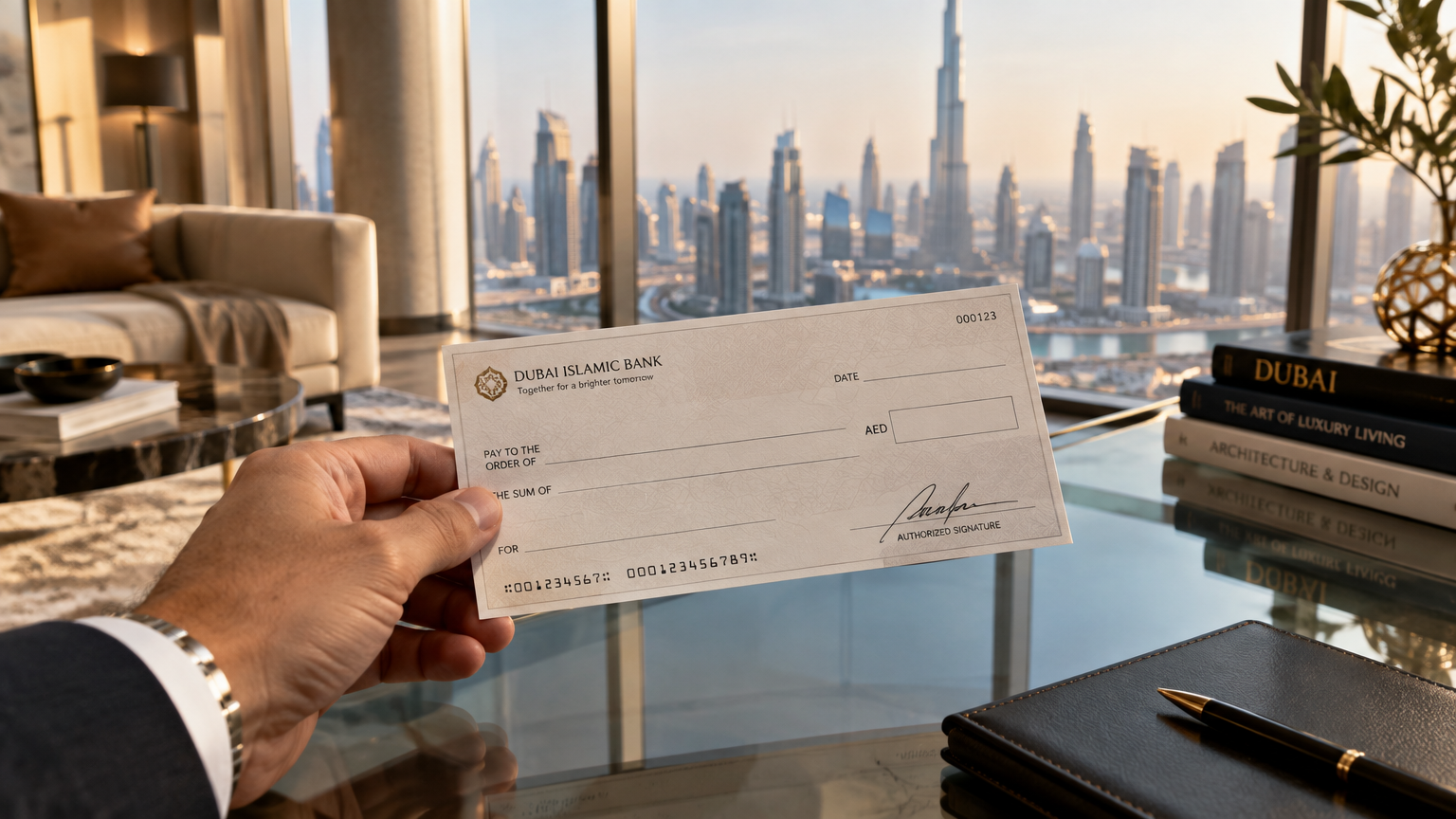
Dubai Rent Cheque Payment Guide 2026
Quick Summary
- What “Dubai rent cheque payment” means: post-dated cheques are standard, and the number of cheques directly affects your cash flow and total rent cost.
- Legal framework: RERA & Law No. 26/2007 allow landlord and tenant to agree on payment schedule; if nothing is agreed, the law assumes four instalments.
- Comparison of 1, 2, 4, 6, and 12-cheque (monthly) options: typical premiums or discounts in AED.
- What landlords can and cannot require under law; what you can negotiate.
- Checklist: documents, finances, and contract items to prepare before you sign.
What You Need to Know: Overview of Rent Cheque Payments in Dubai
What is the “cheque payment system”?
In Dubai, “rent cheque” means post-dated cheques (PDCs) covering all your rental payments over the lease term. You hand them to the landlord upfront, each with a date when it should be deposited. Cheques work like instalments: one cheque for the full year, or more cheques spaced throughout the year.
“Dubai rent cheque payment” refers to how many post-dated cheques you give and when they’re cashed. This decision has a real effect on your finances and the overall cost of your lease.
Legal and regulatory basics (RERA, Law No. 26 of 2007)
- Law No. 26/2007 regulates landlord-tenant relationships in Dubai. It requires the lease contract to specify rent, term, and payment method.
- If the payment schedule isn’t agreed or specified, Law 26 requires payment in four equal instalments in advance, annually.
- RERA supervises tenancy rules, rental increase indices, and contract registration (Ejari). Landlords must register the lease contract with Ejari before move-in and before utilities can be connected.
How the Number of Cheques Impacts Cost & Cash Flow
You can usually negotiate 1, 2, 4, 6, or 12 cheques a year (monthly). Sometimes landlords have set preferences, especially in premium areas. Here’s how the practical differences break down.
| Number of Cheques | How It Works | Impact on Your Cash Flow | Typical Premium or Discount on Rent* |
|---|---|---|---|
| 1 cheque (full year upfront) | You hand one cheque covering the full annual rent at signing. | Largest immediate outlay. Liquidity becomes tight, but you make no further rent payments during the year. | Discount of 5–10% in AED vs standard four-cheque rate. |
| 2 cheques (every six months) | Two post-dated cheques, each covering half the year’s rent. | Still heavy upfront but split into two payments. More manageable than one. | Slight discount vs four cheques—approximately 2–4% lower. |
| 4 cheques (quarterly) | Most common structure; cheques due every three months. | Balanced cash flow; you prepare funds four times per year. | Usually “standard market rent”—neither premium nor major discount. |
| 6 cheques (every 2 months) | Six PDCs due every two months. | Easier cash flow; less burden early in the lease term. | Slight premium over four-cheque rate, approximately 1–3% higher. |
| 12 cheques / monthly | 12 payments, one per month; aligns with how many expats budget. | Most tenant-friendly for monthly budgeting; lowest per-instalment outlay. | Highest rent charge; premium of 2–5% or more depending on area and property type. |
*All premiums and discounts are relative to the “market standard” for a four-cheque structure. Actual amounts vary by area (Downtown, Marina, Business Bay, JBR), property type, landlord preference, and demand.
Can I Pay Monthly in Dubai, and What Will It Cost Me Extra?
Yes—but only if the landlord agrees. There is no legal obligation for a landlord to accept a monthly payment schedule. The law allows flexibility; if you and the landlord agree, 12 cheques or monthly payments are valid.
If you request monthly payments (12 cheques), expect these additional costs:
- Higher rent: Typically 2–5% more than four-cheque payments.
- Larger security deposit or proof of income: Landlords often request stronger financial verification.
- More detailed vetting: To ensure you can reliably meet monthly instalments.
For example, consider a one-bedroom apartment in Business Bay listed at AED 80,000 per year. Structure costs might break down approximately as follows:
- 1-cheque price: AED 72,000–76,000 (with 5–10% off)
- 2 cheques: AED 78,000–79,000
- 4 cheques: AED 80,000 (baseline)
- 6 cheques: AED 81,500–82,500
- 12 cheques / monthly: AED 82,000–84,000
What Landlords Can and Cannot Demand Under Law
What landlords can require
- Proof of identity, valid residency visa, and Emirates ID.
- Post-dated cheques for the full lease term. The number of cheques is negotiable, but tenants must provide PDCs.
- Security deposit (commonly 5–10% of annual rent depending on furnishing) plus agent commission (approximately 5%) and Ejari registration fee.
What landlords cannot legally force
- A specific number of cheques if both parties agree to a different structure. The law does not fix the number of instalments.
- An arrangement without contract registration (Ejari). All contracts must be registered with RERA, per Law 26.
- Arbitrary rent increases outside RERA’s rent index rules upon renewal.
Local Variations & Market Trends by Area
- Upscale areas like Downtown, Dubai Marina, and JBR: Landlords often insist on 1–2 cheques upfront and offer discounts for fewer cheques.
- Newer or managed developments: More landlords offer flexibility with 6–12 cheques or monthly payments, sometimes through “Flexi Rent” programs. Dubai Land Department’s Flexi Rent initiative introduced payment plans including monthly instalments.
- Less central areas or older stock: Four cheques remain the standard. Monthly payments may be accepted only at a premium.
Checklist: What to Prepare Before You Sign
Financial readiness
- Calculate your liquidity: Can you afford one lump-sum cheque, or do you need monthly payments?
- Factor in extra upfront costs: security deposit, agent fees (approximately 5%), Ejari fee (approximately AED 220), and DEWA deposit.
Documents
- Passport and visa.
- Emirates ID.
- Proof of income or employment letter.
- References from a previous landlord or employer.
Understand the cheque schedule fully
- Confirm exact dates, amounts, and cheque numbers.
- Know who holds the cheques (agent or landlord).
- Understand consequences if a cheque bounces (late fees and legal action).
Read the contract carefully
- Ensure the payment method and number of cheques are clearly stated in writing.
- Check for clauses about rent increase, cancellation, and renewal terms.
- Confirm that Ejari registration is included.
Negotiate upfront
- If you want monthly or fewer cheques, propose this early in discussions.
- Be prepared to offer something in return, such as slightly higher rent or a larger security deposit.
Frequently Asked Questions
Q1: Is there a law that rent must be paid in 4 cheques in Dubai?
A: No. Law 26/2007 only mandates four equal instalments if no schedule is agreed upon. If you and the landlord agree on monthly payments (12 cheques) or any other structure, that arrangement is legal.
Q2: What happens if a cheque bounces?
A: Bouncing a rent cheque is serious. It constitutes a breach of contract and can lead to legal action, claims through the Rental Dispute Center, and damage to your rental history. Always ensure sufficient funds will clear the day before deposit.
Q3: If I pay all rent upfront with one cheque, how much can I save?
A: You can expect a 5–10% discount compared to the standard four-cheque rent in many areas—sometimes more in premium locations. However, only pursue this option if you can cover the full amount upfront.
Q4: Can landlords force me to agree to fewer cheques?
A: Landlords can request fewer cheques but cannot legally force a tenant into a payment schedule they did not agree to. If you refuse, they can select another tenant; outcomes vary by market conditions. Negotiation is key.
Q5: Are there alternatives to cheque payment?
A: Yes—bank transfers, standing orders, or schemes offered under the “Flexi Rent” initiative. However, these remain less common and are typically available only through large corporate landlords or managed developments.
Ready to Get Started?
You now understand your rights, what to expect with different “Dubai rent cheque payment” structures, how much extra flexibility costs, and how to protect your finances. Before you make a decision, get a free rental valuation or speak with a Dubai letting agent today. They can show you exactly what payment plans are available in your area and for your budget—with no surprises.
With this guide, you’ll be informed and empowered to negotiate a rental deal in Dubai that suits your cash flow, legal obligations, and peace of mind.